
Creating a classroom where students feel safe, connected, and valued requires us to move beyond the mindset that fair always means equal. In reality, fairness in education means meeting each student where they are and giving them the tools, support, and opportunities they need to succeed — even if that looks different for each learner.
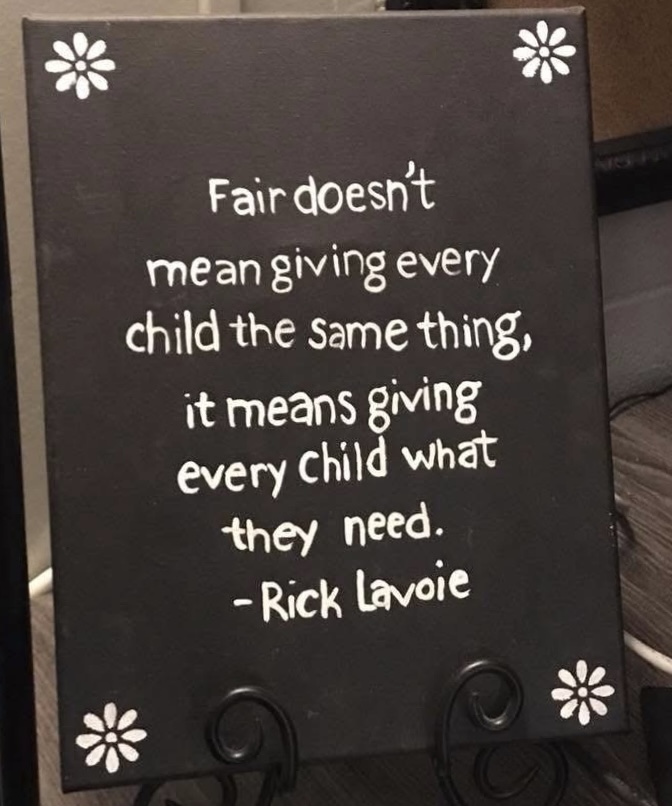
This shift is not just about instructional strategies; it’s about empathy, psychological safety, and fostering a sense of belonging. When students understand that everyone’s needs are different, classroom communities become stronger, safer, and more collaborative. When I became an assistant principal many years ago, my role was focused on student advocacy. I was the 504 coordinator, and the RTI coordinator, which led me to learn more about equitable access for all students. A teacher gave me this wonderful gift–a canvas with a quote that became a mantra.
Fair vs. Equal: A Mindset Shift
- Equal means the same — everyone gets identical treatment, assignments, or supports.
- Fair means equitable — each student receives what they need to thrive.
By helping students understand this distinction, we foster empathy rather than resentment and build a classroom culture grounded in psychological safety and belonging. We will no longer hear from students, “Why does she get to have more time and I don’t?”, or “I don’t understand why he leaves the classroom every day for a few minutes, but I never get to.” It also gives adults the autonomy to respond to students with compassion and empathy first, and to not have to worry about addressing behaviors publicly. Students learn to trust that the adult has the situation under control and that students won’t always see the whole picture—in fact, very rarely should they if we are treating all students with dignity and respect.
Understanding what the words fair, equal, same, different, empathy, and the concept of assuming positive intent are the most important foundation of a safe and supportive community where everyone has access to belonging. When these core ideas are not the focus, we see students who are socially separated from their peers. Young people will treat other young people the way WE treat young people.
Teaching Fairness Through an Empathy Model
1. Use Everyday Examples
Give students concrete, relatable scenarios:
- “If one student breaks their arm, they need help carrying their books. That doesn’t mean everyone gets help — it means we give them what they need.”
- “Imagine someone forgot their lunch. Offering them food isn’t unfair; it’s helping them have what they need to learn.”
2. Create Classroom Conversations
Facilitate short, structured discussions:
- Prompt: “What’s the difference between treating everyone the same and giving everyone what they need?”
- Activity: Students brainstorm examples where fairness and equality look different, then share as a group.
3. Model Language That Promotes Belonging
Teachers can normalize differences by using consistent phrasing:
- “In our classroom, fair means everyone gets what they need to be successful.”
- “What’s fair for you might look different than what’s fair for someone else — and that’s okay.”
- “We all have strengths and challenges, and we support each other.”
4. Build Shared Agreements
Collaboratively create a classroom charter or norms:
- “We will celebrate differences.”
- “We will support one another’s needs.
- “We will practice empathy when someone needs something different than we do.”
Supporting Psychological Safety and Belonging
Research consistently shows that students thrive academically and emotionally when they feel safe, supported, and connected:
- Psychological Safety: When students know they can ask for help, make mistakes, and express needs without fear of embarrassment, their engagement and achievement increase (Edmondson, 2019).
- Belonging: A sense of belonging directly impacts motivation, self-regulation, and learning outcomes (Walton & Cohen, 2011). When students believe they matter, they are more likely to persist through challenges.
Putting It Into Practice: Classroom Scenarios
| Scenario | Equal Response | Fair Response | Teaching Opportunity |
| Student with ADHD struggles to complete work in time | Give everyone 30 minutes, regardless of need | Allow extended time and a quiet workspace | Discuss how brains work differently and why support matters |
| Student misses school due to illness | Require them to finish all missed assignments immediately | Prioritize essential tasks and scaffold re-entry | Highlight how fairness considers individual circumstances |
| Student experiences anxiety during group presentations | Require everyone to present in front of the class | Offer alternative options like small groups or recorded presentations | Talk about how safety and success look different for each student |
Example Lesson Plans to Teach Fairness and Empathy
Lesson Plan 1: Elementary (Grades K–5)
Objective: Students will understand the difference between “fair” and “equal” and practice empathy.
Time: 30 minutes
Materials:
- Band-Aids (real or paper cutouts)
- Chart paper or whiteboard
- Markers
Activity:
- Hook (5 min): Tell students, “Everyone gets a Band-Aid today, but I’ll put it on your hand.”
- Scenario (10 min): Explain that some students might have “injuries” in different spots (knee, finger, shoulder). Ask:
- “Would it be fair if everyone got the Band-Aid on the same spot?”
- Discussion (10 min):
- Define equal = same and fair = giving people what they need.
- Have students brainstorm other classroom examples (help reading, extra time, sitting near the teacher).
- Reflection (5 min):
- Create an anchor chart titled: “Fair ≠ Equal: We All Get What We Need.
Core Phrase:
“Fair means everyone gets what they need to succeed.”
Lesson Plan 2: Middle Level (Grades 6–8)
Objective: Students will explore fairness through perspective-taking and empathy-building.
Time: 45 minutes
Materials:
- Scenario cards (e.g., different learning needs, home situations, language barriers)
- Sticky notes
- Chart paper
Activity:
- Scenario Sorting (15 min):
- In small groups, students read short scenario cards:
“Alex struggles with reading aloud.”
“Jordan doesn’t have Wi-Fi at home.” - Students discuss what would be equal vs. fair in each scenario.
- In small groups, students read short scenario cards:
- Class Discussion (15 min):
- Invite groups to share solutions and connect ideas to real classroom practices.
- Invite groups to share solutions and connect ideas to real classroom practices.
- Empathy Wall (10 min):
- Students write one thing on sticky notes: “I need ___ to learn best.”
- Post them anonymously to build awareness of different needs.
- Wrap-Up (5 min):
- Reinforce classroom norms: “Fairness builds belonging.”
- Reinforce classroom norms: “Fairness builds belonging.”
Lesson Plan 3: Secondary (Grades 9–12)
Objective: Students will analyze fairness in education and society, practicing critical thinking and empathy.
Time: 50 minutes
Materials:
- Case studies (e.g., grading policies, resource allocation, accommodations)
- Discussion prompts
Activity:
- Opening Question (5 min):
- “Is treating everyone the same always fair?”
- Students write quick reflections.
- Case Study Analysis (20 min):
- Provide real-world examples (e.g., students with IEPs, AP testing accommodations).
- Groups decide: Is the solution equal, fair, or both? Why?
- Class Debate (15 min):
- Facilitate structured dialogue around one case study where fairness and equality conflict.
- Personal Reflection (10 min):
- Students write about a time they needed something different to succeed.
Extension:
Invite students to create advocacy projects on equity issues in education, connecting classroom fairness to broader societal topics.
Why Every Educator MUST Believe This Matters
Classrooms built on empathy and fairness foster:
- Safety: Students feel secure expressing needs and challenges.
- Connection: Relationships strengthen when differences are understood and respected.
- Engagement: Students invest more in learning when they feel valued.
- Equity: Every learner has the opportunity to succeed on their terms.
When educators commit to a “fair, not always equal” mindset, they model compassion, normalize differences, and teach students a vital life skill: how to thrive together in diverse communities. Adults modeling this mantra daily will make a difference in the level of engagement of students, and it will decrease undesired behaviors. When students FEEL empathy and compassion, they understand what it means. They have to feel it before they can express it to others. They have to experience it in order to feel belonging and safety. We are charged with making this our top priority in every interaction we have with young people, and with our colleagues.
References
- Edmondson, A. (2019). The Fearless Organization: Creating Psychological Safety in the Workplace for Learning, Innovation, and Growth.
Walton, G. M., & Cohen, G. L. (2011). A brief social-belonging intervention improves academic and health outcomes among minority students. Science, 331(6023), 1447-1451.
 Learning and Leading: A Joyful Leader's Journey