What Are Executive Functions?

Executive function skills are essential cognitive processes that enable students to plan, focus attention, remember instructions, and juggle multiple tasks. These skills—working memory, cognitive flexibility, and inhibitory control—are foundational for academic success and lifelong learning. As an educator, understanding how these functions develop and how they manifest in the classroom can dramatically improve how we support students—particularly those who struggle with focus, organization, or emotional regulation.
Executive functions are regulated by the brain’s prefrontal cortex, the region responsible for higher-order thinking, decision-making, and self-regulation. These skills begin developing in early childhood and continue into the mid-20s, with adolescence being a crucial period for refinement.
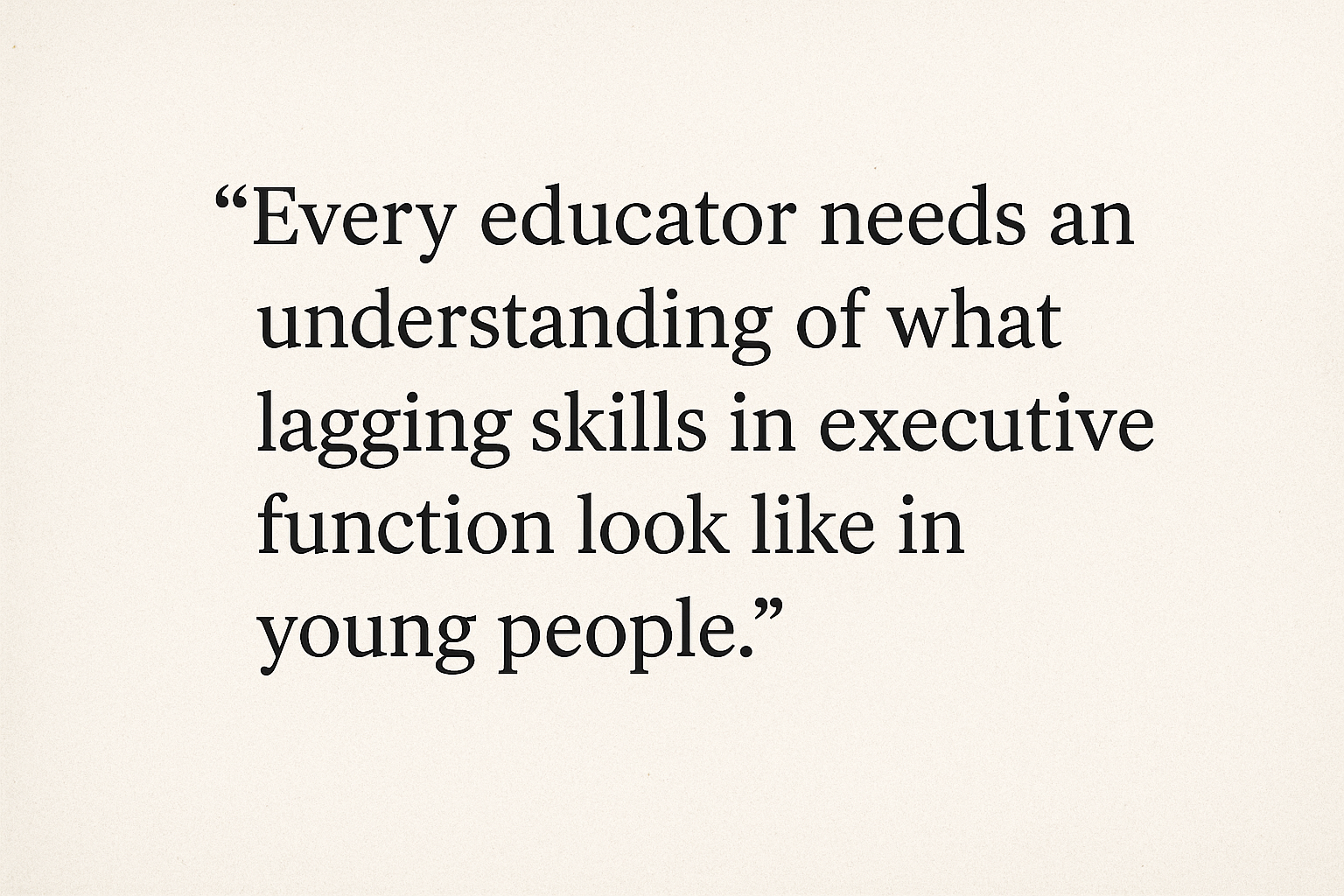
Some of our most vulnerable students in schools are being punished, excluded, restrained, secluded, paddled, suspended, and expelled because they lack executive functioning development that matches their chronological age. When these young people are continually redirected, corrected, and assigned consequences that don’t match the action, and that happen without connection and compassion, they ultimately wind up with no sense of safety or belonging in their school. Rewards, incentives, contingency plans, and token economies are practices that are based on extremely antiquated theories of behaviorism. The victims of these practices are the students who lack the schools to reason out and work within those systems. The students who are successful in those systems already have the skills necessary to be successful and become reliant on what they get out of those systems. This issue is of great urgency. We must empower educators with the knowledge, skills, and dispositions required to teach ALL students in brain-aligned ways.
Important Note on Brain Development:
Brain age and chronological age are not always aligned. A 13-year-old student may have a prefrontal cortex that functions more like that of a 10-year-old (or younger) in terms of executive control. Some students enter the school system as four or five year olds, with brain ages of toddlers. When we see behaviors like tantrums, running from adults, refusal to transition, difficulty initiating tasks, and impulse control, the brain age of the young person is likely lagging from their chronological age. This lag is often seen in students with ADHD, trauma exposure, excessive exposure to screens, lack of healthy attachments with adults, or developmental delays. It is important to remember this, because students are often punished for these behaviors that are more than likely beyond their control due to lagging brain development.
Working Memory
Definition: Working memory is the ability to hold and manipulate information in mind over short periods. It is essential for following multi-step directions, solving problems, and processing language.
In the Brain:
Working memory relies on the dorsolateral prefrontal cortex, which integrates information from various brain regions. Research shows that this area matures gradually, peaking in development in the late teens to early twenties (Luna et al., 2010).
What Hinders Development?
- Chronic stress and trauma disrupt the brain’s ability to retain information.
- Sleep deprivation reduces prefrontal cortex efficiency.
- ADHD and other neurodevelopmental disorders affect working memory capacity.
Classroom Scenarios:
- A student forgets the second and third steps of a math problem after the teacher explains all the steps at once.
- A child starts writing a sentence but can’t remember the subject by the time they reach the verb.
- During group work, a student struggles to remember the group’s plan and repeats earlier ideas.
Strategies for Support:
- Break instructions into smaller, manageable parts.
- Use visual reminders and checklists.
- Incorporate memory games or rehearsal strategies.
- Remember that lagging working memory can mask as “not listening” or “not paying attention”.
Cognitive Flexibility
Definition: Cognitive flexibility is the ability to shift thinking, adapt to new rules, and see problems from multiple perspectives. It is critical for problem-solving and social interactions.
In the Brain:
This skill involves coordination between the anterior cingulate cortex and prefrontal regions, which mature through adolescence. According to Zelazo & Carlson (2012), flexibility is one of the last executive functions to fully develop.
What Hinders Development?
- Rigid classroom routines with little variation can underdevelop flexibility.
- High-pressure environments limit risk-taking and adaptive thinking.
- Autism spectrum disorder is commonly associated with reduced cognitive flexibility.
Classroom Scenarios:
- A student becomes frustrated when the teacher changes the seating chart unexpectedly.
- A child can’t switch from one math strategy to another even after being shown it’s more efficient.
- During a class discussion, a student struggles to accept different viewpoints or consider alternative solutions.
Strategies for Support:
- Encourage multiple problem-solving strategies.
- Use “what if” scenarios to explore alternative perspectives.
- Normalize mistakes and model flexible thinking–model this by talking it out.
Inhibitory Control
Definition: Inhibitory control is the ability to resist impulses, stay focused, and filter out distractions. It’s essential for behavior regulation and task completion.
In the Brain:
This function is governed by the ventrolateral prefrontal cortex and basal ganglia, which continue developing into the mid-20s. The marshmallow test by Mischel (1972) famously highlighted this skill as a predictor of later success.
What Hinders Development?
- Overstimulation (e.g., noise, screen time) makes it harder to filter distractions.
- Inconsistent discipline at home or school reduces impulse control.
- Poor nutrition or lack of physical activity can impair self-regulation.
Classroom Scenarios:
- A student frequently blurts out answers before being called on.
- A child fidgets constantly and struggles to remain seated.
- A student begins a writing task but gets up every few minutes without completing it.
Strategies for Support:
- Normalize apologizing to students when you react emotionally in front of them.
- Use behavior cueing systems (visual or auditory).
- Provide structured movement breaks
- Teach mindfulness and self-regulation strategies explicitly.
Final Thoughts for Educators
Understanding executive function is not about labeling students as “disorganized” or “disruptive.” It’s about recognizing developmental lag and the brain’s capacity to grow with the right supports. Executive function is not fixed—it is plastic, especially during childhood and adolescence. Our brains have neuroplasticity! With the right scaffolding, modeling, and opportunities to practice, all students can strengthen these essential life skills. When you see a person differently, you see a different person. Be patient—students are often doing the best they can with the brain they have. Scaffold tasks to support executive function development. Collaborate with families and specialists when concerns arise.
Model your own use of executive function strategies—your students are watching.

Bethany
 Learning and Leading: A Joyful Leader's Journey