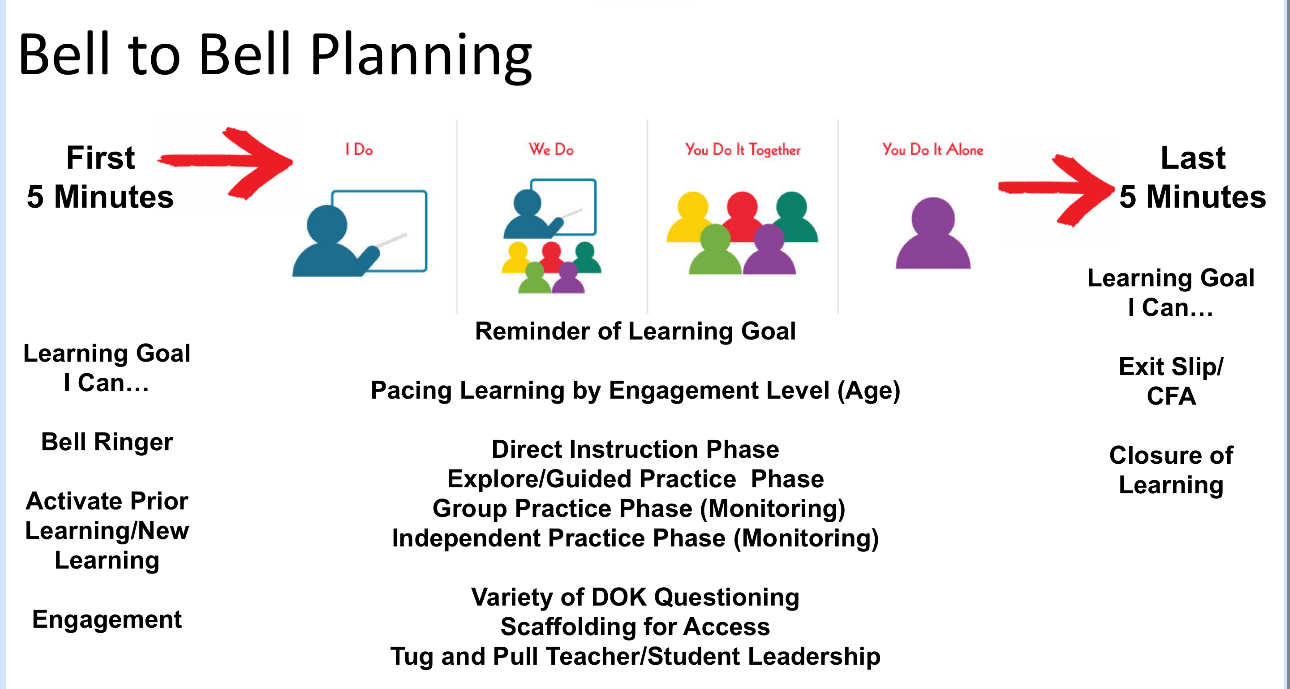
In effective and highly effective classrooms, learning doesn’t just happen — it’s planned with intention from the moment the bell rings to the moment it rings again. Bell to Bell Planning is more than a time-management strategy; it’s a framework for creating safety, belonging, engagement, and purposeful learning for every student.
When we intentionally design every phase of the lesson — from the first five minutes to the last — we ensure that students feel supported, challenged, and valued. Here’s how to break it down. Whether you are a kindergarten teacher who teaches multiple contents throughout the day to the same group of students, or you are a high school teacher who focuses on a specific content with multiple class periods of students, bell to bell learning is attainable!
The First Five Minutes: Setting the Tone
Purpose: Safety, belonging, and engagement start the moment students enter the room.
- Make deposits through connections as students enter the room!
- Have a plan for non-instructional “things”, like attendance, turning in documents, etc.
- Learning Goal (I Can…, Let’s…) – Posting and verbally sharing the learning target at the beginning of the class time, helps students feel anchored. They know what’s expected and how success will be measured — an important part of psychological safety.
- Bell Ringer/Warm-Up – A consistent, predictable starter task signals that learning begins right away, reducing downtime and maintaining urgency.
- Activate Prior Learning/New Learning – Connecting today’s work to what students already know builds belonging by valuing their experiences and prior knowledge.
- Engagement – Quick, low-stakes activities (e.g., a warm-up question, mini-discussion) create immediate participation, building momentum.
- The first five minutes could actually be anywhere from five to ten minutes, depending on the amount of time of the class period, the use of high quality materials that have specific pacing of lessons, and/or the detail of the bell ringer/warm-up you are using.
Safety & Belonging Focus: Greet each student by name at the door daily, reinforcing the message: I see you, you belong here, and your presence matters. You can also add a quick question to the bell ringer that focuses on connection. For example, “Is there anything you want me to know?” on the first day coming off of a weekend or extended break from school. Also…be sure your classroom door is locked! This is a communication of physical safety, and students know that if they leave, there is a routine and procedures for them to reenter safely.
The Heart of the Lesson: Where Engagement and Relevance Come Together
Did you know that the average attention span of an adult is about 12-15 minutes if we want to transfer information into long term memory? The brain can hold about five to nine chunks of information at a time before a pause is needed to process! Young people need this time as well! For every year of life, you can plan for that many minutes of direct instruction or task focus before you need to pause and allow students to task switch with an opportunity to move, talk, read, write, etc. Use this “heart” of the lesson to chunk your time in such a way that you support the development of healthy young brains!
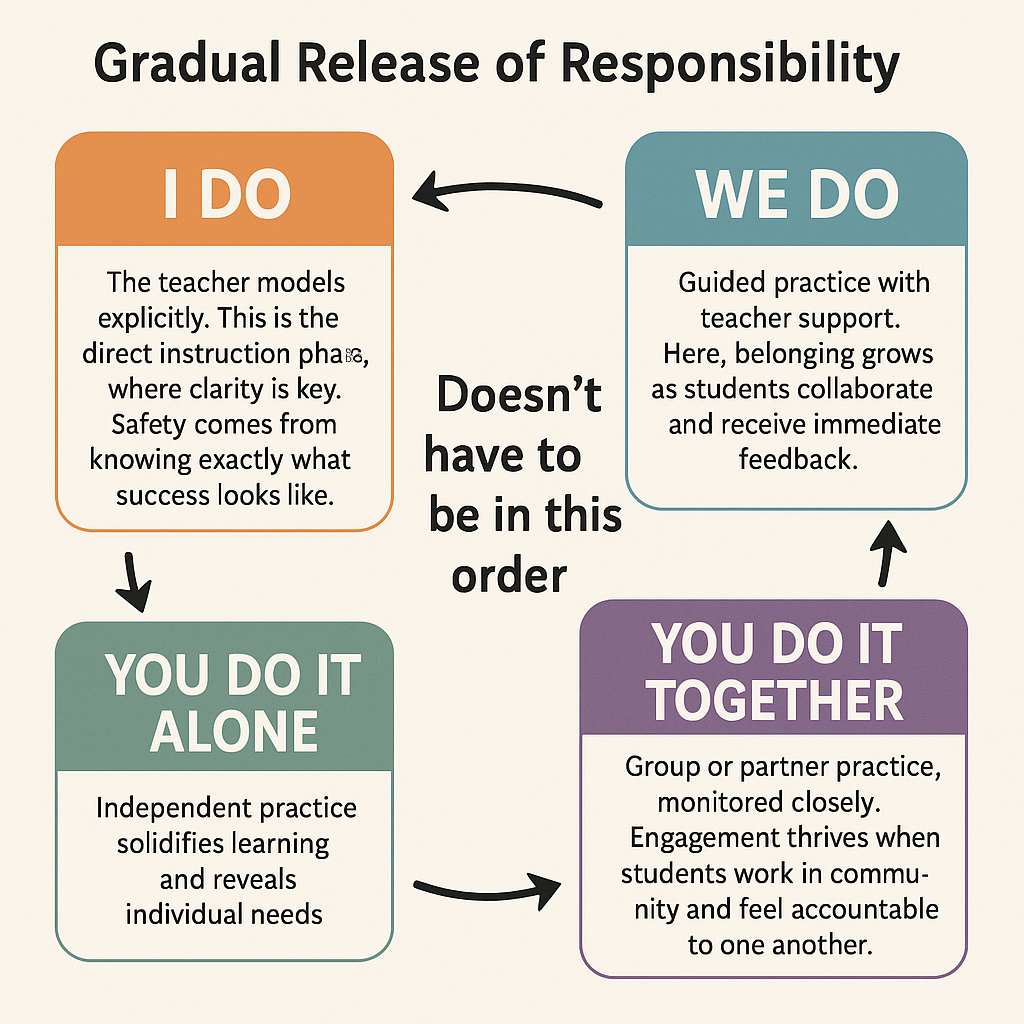
The heart of Bell to Bell Planning involves pacing learning through gradual release:
- I Do – The teacher models explicitly. This is the direct instruction phase, where clarity is key. Safety comes from knowing exactly what success looks like. Vocabulary specific to the learning target will be emphasized during this time.
- We Do – Guided practice with teacher support. Here, belonging grows as students collaborate and receive immediate feedback. Students are the second teacher in the classroom, and will learn with and from their peers when structures are preplanned by the teacher with engagement and rigor in mind.
- You Do It Together – Group or partner practice, monitored closely. Engagement thrives when students work in community and feel accountable to one another. This is a great time to revisit the learning target for a second time in order to get the focus of students to practice with peers. Having roles within groups, along with detailed steps of success criteria for engagement routines will set students up for success and help them meet the intended outcome.
- You Do It Alone – Independent practice solidifies learning and reveals individual needs. This is a way to formatively assess understanding and an opportune time to intervene when you see misconceptions. Planning for misconceptions ahead of time will help you prepare specific prompts you will need to scaffold the learning of individuals.
It is important to note that the gradual release of responsibility does not have to flow in the order that it is presented above! When considering the GRR within specific content, it could be used in a different progression. For example, when solving a problem in an Algebra class, the teacher might pose the problem and have students start with what they know about the information in the problem to begin solving it, making the independent practice or the do together practice come first. Another example is conducting a science experiment with a lab partner to discover a phenomenon, then using that background knowledge to help the teacher explicitly teach the content related to what they learned in the experiment.
Bottom line: EVERY lesson is stronger with all components planned with students in mind!
Environment Focus: Arrange the room to support movement between these phases — from direct instruction spaces to collaborative groupings — making transitions smooth and efficient. Consider having multiple arrangements of furniture and building routines/procedures for students to help you with the room arrangement that will best support the learning target of the day.
The Last Five Minutes: Closing the Loop
Purpose: Students leave with clarity and confidence, knowing where they stand in their learning.
- Revisit Learning Goal – State or have students state the“I Can” (“Let’s”) statement, reinforcing ownership of learning. Have a quick moment of reflection where they can discuss as a class or with a peer to sum up the focus of the time spent on this learning goal.
- Exit Slip–Gather quick evidence of learning to inform your next steps. This responsiveness shows students their progress matters. You may decide that this exit slip needs to be a CFA (Common Formative Assessment) that will be used collaboratively with other teachers for driving intervention on grade level essentials.
- Closure of Learning – Summarize key takeaways and preview what’s next, sustaining engagement beyond the bell. Allow students to self-assess their status of understanding somehow through a whole class check, and out-the-door status of the class chart, or make this part of your exit slip to see where students are emotionally regarding the learning.
Urgency Focus: Protect these last minutes fiercely — they’re essential for feedback loops and planning responsive instruction. Many discipline referrals happen the last five minutes of class when that time is not structured with extreme focus. The closure is important for their ability to begin transferring information to long term memory later (this happens when we sleep!), but also to help students understand you see them and hear them from an emotionally connected standpoint. Have a “goodbye” ritual, just as you have the ritual of greeting students at the door. This sets up for success the next time!
Urgency and Responsiveness: The Teacher’s Overarching Mindset
- Urgency means every minute is used with intention. Transitions are tight, materials are ready, and students sense that learning time is precious. There are specific goals for the class, as well as for individual students, and the feedback you provide will reinforce your sense of urgency for them to learn and demonstrate growth. Students can feel the urgency without feeling negative pressure from adults. Communicating relevance fosters the collective need for urgency.
- Responsiveness means adjusting pacing, grouping, or strategies based on real-time observations and student needs. When students see that your teaching shifts because of their feedback and performance, they feel both respected and supported. This is the ultimate communication of safety and belonging within a learning community, because students will be more likely to be unafraid of making mistakes, taking risks, and participating in discussions with you and with their peers. Preparing through intentional planning of scaffolding specific learners or groups of learners, and having some built-in tools or routines you can bring into any lesson are the key to being responsive within a well timed out class period.
To Sum it Up…
Bell to Bell Planning isn’t just about “keeping kids busy.” It’s about:
- Building safety through clear expectations and predictable routines
- Fostering belonging through relationships and relevance
- Increasing engagement by connecting, challenging, and celebrating learning
When we combine these with an urgent and responsive approach, bell to bell learning will become the norm within the walls of your classroom, and you will habitually transform each minute of class into an opportunity for growth for all students.
Bethany
Research and References
- The importance of intentional planning and pacing in instruction:
- Marzano, R. J. (2007). The Art and Science of Teaching: A Comprehensive Framework for Effective Instruction. ASCD.
- Andrade, H., Du, Y., & Wang, X. (2020). Powering formative assessment with AI: Toward an equitable technology-enhanced classroom. Educational Researcher, 49(7), 467-474.
- Gradual release of responsibility model:
- Fisher, D., & Frey, N. (2008). Better Learning Through Structured Teaching: A Framework for the Gradual Release of Responsibility. Educational Leadership, 66(3), 64-67.
- Creating a safe and collaborative classroom environment:
- Cornelius-White, J. (2007). Learner-centered teacher-student relationships are effective: A meta-analysis. Review of Educational Research, 77(1), 113-143.
- Brown, C., et al. (2021). Building belonging and resilience through classroom community practices. Learning and Instruction, 75, 101530.
- Gorham, K. S., & Zandalasindi, R. (2022). Relationship-building as a foundation for inclusive and engaging classrooms. Educational Psychology Review, 34, 553-578.
- The role of formative assessment and feedback:
- Black, P., & Wiliam, D. (1998). Inside the Black Box: Raising Standards Through Classroom Assessment. Phi Delta Kappan.
- Building engagement and relevance:
- Desimone, L. M. (2009). Toward a Theory of Effective Teacher Professional Development. Journal of Teacher Education, 60(5), 517-529.
- The significance of routines and clear expectations:
- Marzano, R., Marzano, J. S., & Pickering, D. (2003). Classroom Management That Works: Research-Based Strategies for Every Teacher. ASCD.
- Attention span and chunking in instructional design:
- Sweller, J. (1988). Cognitive Load During Problem Solving: Effects on Learning. Cognitive Science, 12(2), 257-285.
- . Mayer, R. E. (2020). Applying cognitive theory to multimedia learning. The Psychology of Learning and Motivation, 73, 117-148.
 Learning and Leading: A Joyful Leader's Journey
Love this – especially appreciate the reminder of the value of (guided) gradual release of responsibility and the 5(ish) first minutes being so powerful to help create a tone – just wish our system was not regulated by the preset bell structure that makes the “closing time” to be helpful for transitioning also important… I’m always so bad at that… way too many times the end of day surprised all of us…
LikeLike